
Part 1 of Everything You Believe About Fundraising is Wrong: 9 Mistakes That Are Killing Your Results
"I'm sick of apologizing for being in charge of raising money."
That's the opening line of one of the most widely shared documents in the nonprofit world: Sasha Dichter's "Manifesto in Defense of Raising Money," written in 2008.
At the time, Dichter was the Chief Innovation Officer at Acumen, a pioneering organization fighting global poverty. He believed in the work. He was good at it. And yet when a mentor heard he was taking on a role that involved fundraising, the mentor pulled him aside and warned him: "Be careful. You'll get pigeon-holed. Once a fundraiser, always a fundraiser."
Note: this wasn't an outsider. It was an experienced leader inside the non-profit sector, treating fundraising as a career stain.
In his manifesto, Dichter presented a simple, furious response.
"You're devoting your life, your spirit, your energy, your faith into making the vision you have of a better future into a reality," he wrote. "So why are you so scared to ask people for money?"
This is one of the most important, transformative questions non-profit leaders can ask themselves. Transformative, because if they answer it correctly, it will change literally everything they do as a non-profit leader for the better.
The belief that poisons the well
Often, the organizations that struggle most with fundraising don't lack for good programs, passionate staff, or worthy missions. What they lack is a healthy relationship with the act of asking for money.
And I don't mean they lack technique. I mean something deeper.
They believe, at a gut level, that fundraising is…well…embarrassing. That it's awkward. That it's morally indistinguishable from begging. That it's something you have to do, so that you can get around to doing the real work of the organization. That donors are doing them a favour, and that every ask carries with it an implicit apology.
I call this belief the original sin of nonprofit fundraising. Not because it's the most dramatic mistake an organization can make, but because it's the one from which so many others flow.
If you believe fundraising is embarrassing, you won't get good at it. Full stop. And your mission will suffer.
You won't invest in learning how to do it well. You won't practice. You won't read the books or listen to the podcasts that might open your eyes to how fascinating fundraising can be. You won't build exceptional systems around it. You'll treat it like a chore to be endured rather than a skill to be mastered.
If you believe fundraising is embarrassing, you'll default to the approaches that feel least like asking. You'll hold expensive, time-consuming events. You'll run bake sales and car washes and silent auctions that leave you and your volunteers exhausted, and raise little money. You'll build elaborate transactional structures designed to obscure the fact that what you really need is for people to give you their money because they believe in what you do.
If you believe fundraising is embarrassing, your executive director won't do it. Your board won't do it. Your volunteers will treat it as the one part of their commitment they'd rather leave to others. And the one person you do hire to handle development will burn out within eighteen months, because they're carrying a weight that should be shared across the entire organization. Very likely, they'll spend the entire time feeling as if they're fighting an uphill battle, having to continually convince the executive director and board to actually include fundraising language in organizational documents, or to include explicit asks at events.
If you believe fundraising is embarrassing, your donors will feel it. People are remarkably attuned to the emotional signals of the person sitting across from them. A fundraiser who approaches a donor apologetically, tentatively, with the energy of someone asking for a favour they don't quite deserve, will get a very different response than one who approaches with ease, confidence and conviction.
As one writer in the field put it: "If you're not comfortable enough in yourself or your program to ask someone for money, why would they be comfortable enough to give it to you?"
The reframe that changes everything
So here's the question: what if fundraising isn't an imposition at all?
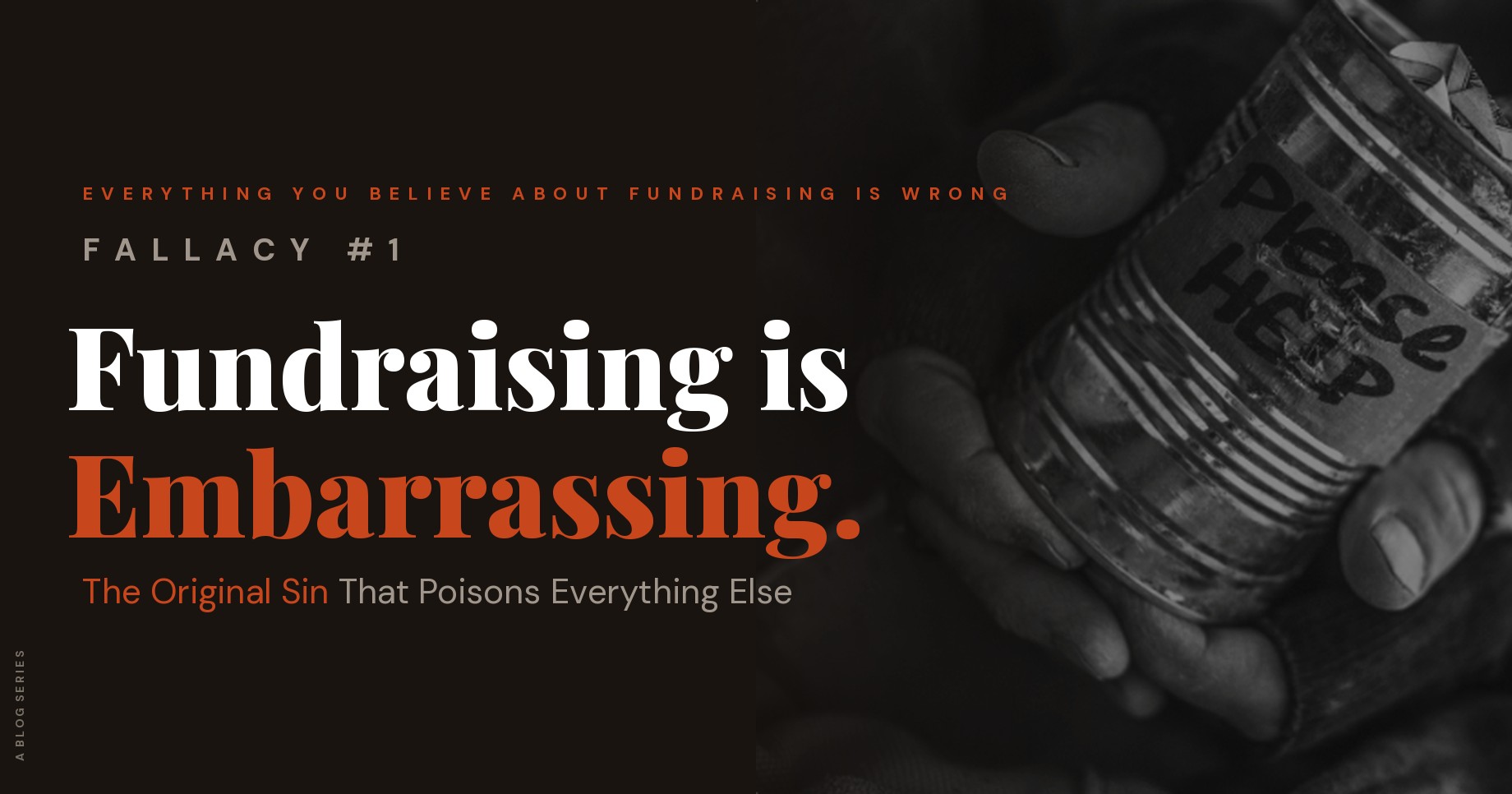
What if, instead of thinking of yourself as someone with your hand outstretched like a beggar with a tin cup, you thought of yourself as someone with your hand outstretched in invitation for a firm handshake with a partner?
This is the reframe that transforms fundraising from something you endure into something you can actually take pride in.
When you ask someone to support your organization, you are not asking for a favour. You are presenting them with an opportunity. An opportunity to put their resources behind a cause they care about. An opportunity to be part of something larger than themselves. An opportunity to make a difference that they could not make alone.
"People think that asking for money is all about asking for money," wrote Dichter. "It is and it isn't. Most of the time it is about inspiring someone to see the world the way you do, and convincing them that you and your organization can actually make that vision into a reality. The resources come second."
Dan Pallotta, whose TED Talk "The Way We Think About Charity is Dead Wrong" has been viewed millions of times, has spent decades hammering the same point from a different angle: the nonprofit sector will never reach its potential as long as it treats its own revenue-generating activities as something to be embarrassed about.
We don't expect Apple to apologize for selling iPhones. We shouldn't expect nonprofits to apologize for raising the money they need to change the world.
Fundraising is…sacred?
Catholic priest Henri Nouwen was one of the most widely read spiritual writers of the twentieth century. He was a professor at Notre Dame, Yale, and Harvard who spent the last decade of his life living in a community for people with intellectual disabilities.
Shortly before his death in 1996, he gave a talk that was later published as a small booklet called A Spirituality of Fundraising. It has quietly become one of the most important texts in the field, for fundraisers of all faiths or no faith.
Nouwen's argument goes to the root of why fundraising makes people uncomfortable, and it offers a reframe so radical that it doesn't just reframe fundraising as tolerable. It makes it sacred.
"Fundraising is precisely the opposite of begging," Nouwen wrote. "When we seek to raise funds we are not saying, 'Please, could you help us out because lately it's been hard.' Rather, we are declaring, 'We have a vision that is amazing and exciting. We are inviting you to invest yourself through the resources that God has given you in this work to which God has called us.'"
Nouwen understood that the embarrassment around fundraising comes from a deeply distorted picture of what's actually happening in the exchange.
This is why Nouwen insisted that fundraising is "not a necessary but unpleasant activity to support spiritual things." It is itself a spiritual act. It is the act of inviting another human being into a relationship built around shared purpose. And that kind of invitation, done with honesty and conviction, is one of the most generous things you can offer another person.
From apology to invitation
I have seen this shift happen in real time with organizations I've worked with. The moment a board chair stops thinking of donor meetings as something painful and starts thinking of them as a chance to share something exciting, the entire dynamic of the conversation changes. The moment an executive director stops hedging and apologizing and instead says, clearly and directly, "Here is what we are building, here is what it costs, and here is what your investment will make possible," the donor across the table leans in instead of pulling back.
But something else happens when this shift takes hold. Once people inside an organization stop treating fundraising as something separate from the mission, they start to see how it belongs everywhere.
The program director starts paying attention to the stories emerging from the work, not because someone told her to collect them for the next appeal, but because she realizes that sharing those stories is itself an act of service. It is, in fact, a part of the mission.
Telling the story of a life changed, a community strengthened, a child who found their footing produces hope. It generates gratitude. It spreads evidence of human goodness in a world that is hungry for it. And yes, it also inspires giving. But the giving is a natural consequence of the storytelling, not its sole purpose.
The finance team starts thinking about how to show donors the real impact of their dollars. The communications team starts writing not to fill a newsletter but to invite people deeper into the mission. The board stops seeing donor cultivation as a task they'd rather delegate and starts seeing it as one of the most meaningful parts of their service. Not only do they quickly see how every hour spent in a donor meeting is one of the most impactful things they can do for their organization, they also start to develop meaningful, fulfilling relationships with the donors. Friendships blossom. The organization flourishes into a community.
Once this shift occurs, fundraising stops being a department and becomes a way of life. A way of being that says: what we are doing here matters, and we are not going to be shy about inviting the world to be part of it.
That is the shift. Not from bad fundraising to good fundraising. But from embarrassment to conviction. From apology to invitation.
And once it happens, everything else follows.
Next in the series: "If We Do Good Work, the Money Will Come" — the comforting lie that lets good organizations off the hook for doing the hard, human work of actually asking.